
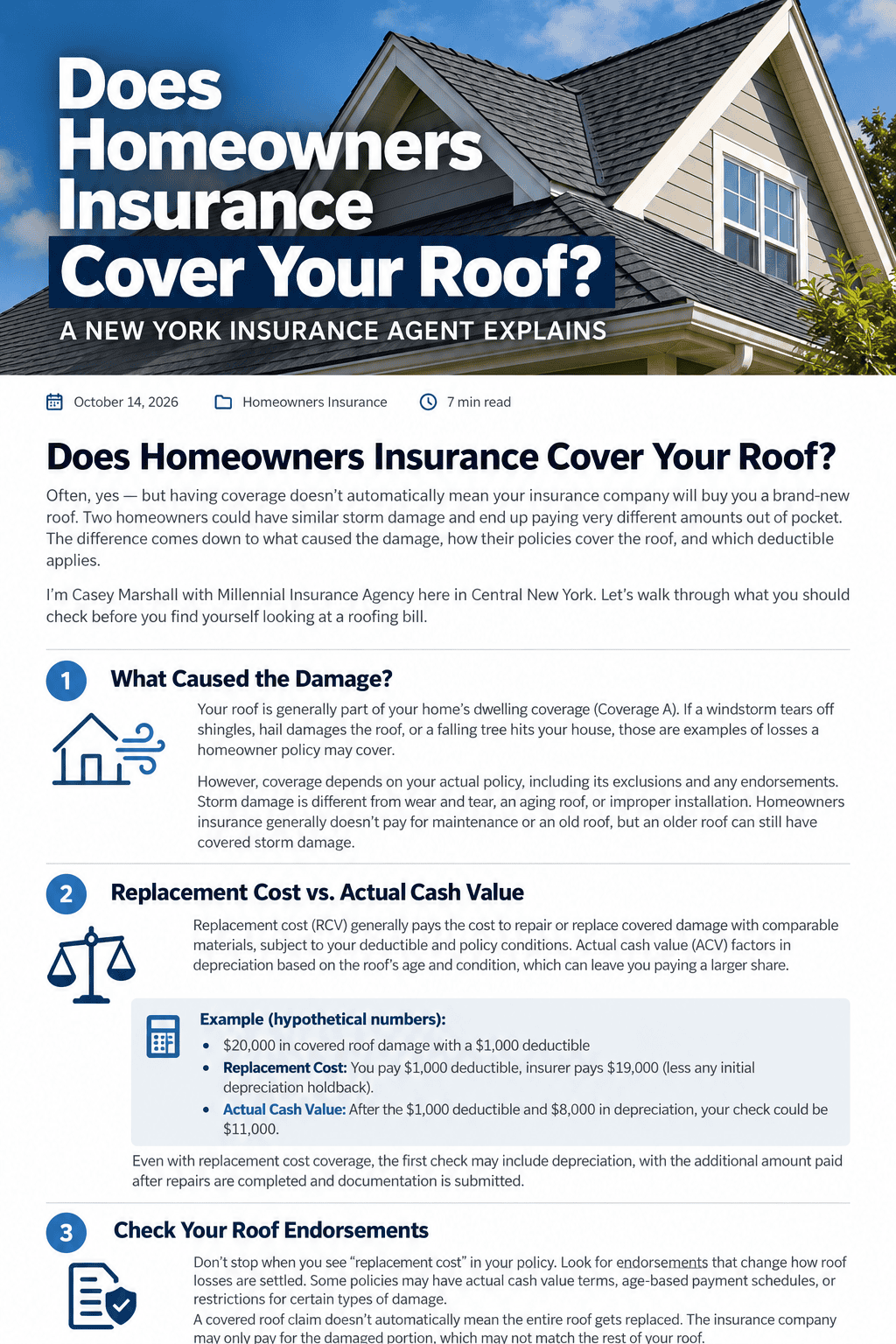
Does Homeowners Insurance Cover Your Roof? A New York Insurance Agent Explains
By Casey Marshall | Millennial Insurance Agency | Morrisville, New York
Does homeowners insurance cover roof damage? Often, yes. But having coverage doesn’t necessarily mean your insurance company will pay for an entirely new roof.
Two homeowners can experience similar storm damage and receive very different insurance claim payments.
Why? It comes down to three important factors:
-
What caused the roof damage?
-
Does your policy cover the roof at replacement cost or actual cash value?
-
What deductible, exclusions, or roof endorsements apply?
I’m Casey Marshall with Millennial Insurance Agency in Central New York. Let’s break down what homeowners should understand about their roof insurance coverage before they’re faced with an expensive repair or replacement.
Watch: Does Homeowners Insurance Cover Your Roof?
Prefer to watch? In the companion video, Casey Marshall of Millennial Insurance Agency explains when roof damage may be covered, replacement cost versus actual cash value, roof endorsements, deductibles, and steps to take after discovering damage.
Watch “Does Homeowners Insurance Cover Your Roof? | New York Insurance Agent Explains” on YouTube.
Keep reading for the claim example, coverage questions, and frequently asked questions you can refer back to after watching.
1. What Types of Roof Damage Does Homeowners Insurance Cover?
Your roof is generally insured under Coverage A – Dwelling of your homeowners insurance policy.
Depending on your policy, covered causes of damage may include:
-
Wind damage: Strong winds tear off shingles or damage roof materials.
-
Hail damage: Hail impacts cause covered damage to shingles or roofing components.
-
Falling trees: A tree falls onto your home during a storm.
-
Heavy snow or ice: Certain types of winter weather damage may be covered, depending on your policy.
However, not every type of roof damage is covered.
What Roof Damage Is Typically Not Covered?
Homeowners insurance generally isn’t intended to pay for normal maintenance or the gradual deterioration of your home.
Common examples include:
-
An aging roof reaching the end of its useful life
-
Shingles deteriorating from ordinary wear and tear
-
Improper roof installation or defective workmanship
-
Damage caused by long-term neglect or lack of maintenance
Here’s an important distinction: An older roof can still experience covered storm damage.
Just because your roof is 20 years old doesn’t automatically mean a windstorm claim will be denied. However, the roof’s age and condition can affect eligibility, coverage terms, and how much your insurance company pays.
The first question should always be: Why does the roof need to be repaired or replaced?
2. Replacement Cost vs. Actual Cash Value: Why It Matters
This is one of the biggest areas of confusion when it comes to homeowners insurance and roof claims.
Replacement Cost Coverage (RCV)
Replacement cost coverage generally pays the cost to repair or replace covered damage with comparable materials, subject to your deductible, policy limits, and conditions.
Actual Cash Value Coverage (ACV)
Actual cash value coverage factors in depreciation, which can substantially reduce the insurance payment.
For roofing, depreciation may be influenced by the roof’s age, condition, and other factors.
Example: A $20,000 Roof Insurance Claim
Let’s assume a covered storm causes $20,000 in roof damage and your policy has a $1,000 deductible.
Claim detailReplacement costActual cash valueCovered damage$20,000$20,000Deductible−$1,000−$1,000Depreciation$0 final deduction−$8,000Total insurance payment$19,000$11,000Your out-of-pocket cost$1,000$9,000
This is a simplified hypothetical example for educational purposes. Actual claim payments depend on policy terms, valuation, depreciation, deductibles, and settlement conditions.
That’s an $8,000 difference between the two insurance settlements.
For many homeowners, that difference could determine whether they can comfortably afford to replace their roof.
Does Replacement Cost Mean You Get the Entire Check Upfront?
Not necessarily.
Some insurance companies initially issue a payment after withholding recoverable depreciation.
Once repairs are completed and the required documentation is submitted, the homeowner may be eligible to recover that withheld depreciation, subject to the policy’s requirements and deadlines.
This is why it’s important to understand not only whether you have replacement cost coverage, but also how your insurance company settles replacement cost claims.
3. Check Your Homeowners Insurance Roof Endorsements
Seeing the words “replacement cost” on your homeowners insurance policy doesn’t automatically guarantee replacement cost coverage for your roof.
Insurance companies may attach endorsements that change how roof claims are handled.
Depending on the policy, these may include:
-
Roof actual cash value endorsements
-
Roof surface payment schedules based on age or material
-
Restrictions involving certain causes of damage
-
Special roof exclusions or settlement conditions
A policy might provide replacement cost coverage for the dwelling while applying a different settlement method to the roof.
Will Insurance Replace My Entire Roof?
Not necessarily.
Even when storm damage is covered, your insurance company may determine that only the damaged portion needs repair or replacement.
For example, if wind damages shingles on one section of your roof, the insurance company may only pay for that section.
What if the new shingles don’t match the existing roof?
Matching requirements and claim settlements depend on your policy, the circumstances, and applicable requirements. Don’t assume that a color difference automatically means the insurance company must replace the entire roof.
The takeaway: Review your actual roof endorsements instead of relying only on the general dwelling coverage listed on your declarations page.
4. Does Homeowners Insurance Cover a Leaking Roof?
Sometimes. The key is understanding what caused the leak.
A leaking roof is a symptom, not necessarily the original cause of damage.
Consider two situations:
Scenario A: Storm Damage
A windstorm damages shingles, allowing rainwater to enter your home.
Depending on your policy, the roof damage and resulting interior water damage may qualify for coverage.
Scenario B: Gradual Deterioration
Your roof has deteriorated over several years, and water begins entering through worn materials.
The roof repairs may not be covered because the cause is ordinary wear and tear or maintenance-related deterioration. Coverage for resulting interior damage must also be evaluated under the specific policy language and circumstances.
It’s possible for the roof itself and the resulting interior damage to be treated differently under your policy.
5. Does Homeowners Insurance Cover Ice Dams and Winter Roof Damage?
Here in Central and Upstate New York, winter weather creates additional risks for homeowners.
Heavy snow, ice buildup, and ice dams can contribute to roof damage and interior water problems.
Some homeowners policies cover certain types of damage involving the weight of snow or ice or resulting water damage. However, the specific coverage depends on the policy form, exclusions, and cause of loss.
Don’t assume every ice dam, roof leak, or snow removal expense is automatically covered.
Preventative roof maintenance and routine snow or ice removal are generally the homeowner’s responsibility unless specific coverage applies.
6. Understand Your Roof Insurance Deductible
Even if the damage is covered, your deductible affects how much the insurance company pays.
Many homeowners policies use a flat deductible, such as $1,000 or $2,500.
Other policies may include separate deductibles for certain storm events, including windstorms or hurricanes.
Some deductibles are expressed as percentages rather than fixed dollar amounts.
For example, if a policy has a 2% wind deductible calculated against a $400,000 dwelling coverage limit, the deductible would be $8,000.
That’s a substantial difference from a $1,000 flat deductible.
If your policy has a percentage deductible, ask your insurance agent what amount it’s based on and which types of claims trigger it.
7. What Should You Do After Discovering Roof Damage?
If you notice roof damage following a storm, taking the right steps can help protect your home and make the claims process smoother.
Document the damage. Take photos of visible roof damage from a safe location. Photograph any interior water damage as well.
Prevent additional damage. Take reasonable, safe steps to protect your property from further damage. Consider qualified professionals for temporary repairs and keep your receipts.
Notify your insurance agent or company promptly. Explain what happened and ask about the claims process.
Coordinate permanent repairs. Give the insurance company an opportunity to inspect the damage when required, and preserve documentation of necessary emergency work.
Remember, a roofing contractor can identify damage and provide repair estimates, but the insurance company evaluates coverage under your policy.
8. Three Questions Every Homeowner Should Ask Their Insurance Agent
Before the next major storm hits New York, ask your agent these three questions:
1. Is my roof covered at replacement cost, actual cash value, or under a roof payment schedule?
This can make a significant difference in your financial responsibility after a covered loss.
2. Are there any roof endorsements or exclusions I should understand?
Ask specifically about limitations that apply to the age, material, or condition of your roof.
3. What deductible applies to a roof insurance claim?
Find out whether you have a flat deductible, a separate windstorm deductible, or a percentage deductible.
Understanding these details before a loss can help you avoid costly surprises.
Need Help Understanding Your Homeowners Insurance in New York?
At Millennial Insurance Agency, we believe homeowners should understand what they’re paying for before they need to file a claim.
As an independent insurance agency based in Morrisville, New York, we help homeowners compare insurance options, review their current coverage, and identify potential gaps.
Whether you’re buying a home, reviewing your renewal, or concerned about an aging roof, we’re happy to help you better understand your insurance.
Contact Millennial Insurance Agency
Website: https://millennial-insurance.com
Phone: 315-825-2665
Location: Morrisville, NY — Serving New York State
More Choices. Better Coverage. Same Local Service.
Frequently Asked Questions About Roof Insurance
Will homeowners insurance pay for a 20-year-old roof?
Possibly. An older roof may still have coverage for sudden, covered storm damage. However, the roof’s age and condition can affect coverage eligibility and claim payment amounts.
Does homeowners insurance cover roof replacement from wind damage?
Wind damage is commonly covered under homeowners insurance, subject to the policy’s terms and exclusions. Whether the insurer pays to repair a section or replace the entire roof depends on the extent of covered damage and applicable policy provisions.
Does homeowners insurance cover an old leaking roof?
Leaks caused by ordinary deterioration or lack of maintenance are generally not covered as roof repairs. However, coverage for resulting interior damage may differ depending on the cause and policy language.
Is replacement cost roof coverage worth reviewing?
Absolutely. Understanding the difference between replacement cost and actual cash value is important because depreciation can substantially increase your out-of-pocket expense after a covered roof claim.
Insurance Disclaimer: This article is provided by Millennial Insurance Agency LLC for general educational and informational purposes only. It does not constitute individualized insurance, legal, or financial advice. Coverage depends on the insurance company, policy form, endorsements, exclusions, deductibles, applicable law, and specific circumstances of a loss. Examples are hypothetical and do not guarantee coverage or claim payment. Reading this article or contacting the agency does not, by itself, establish an agent-client relationship or bind or modify coverage. Consult your policy documents and a licensed insurance professional for guidance regarding your specific situation.